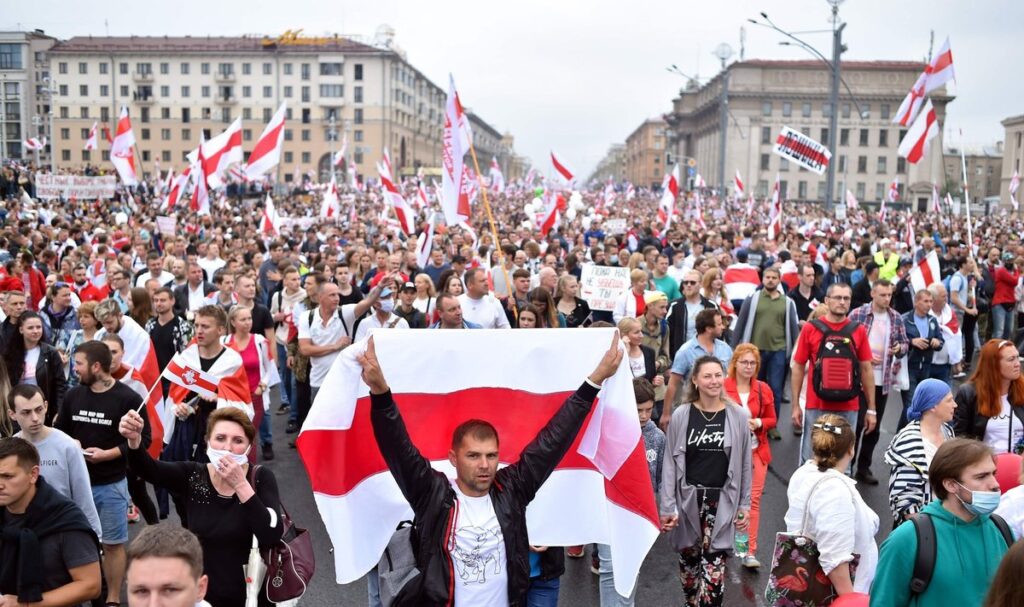

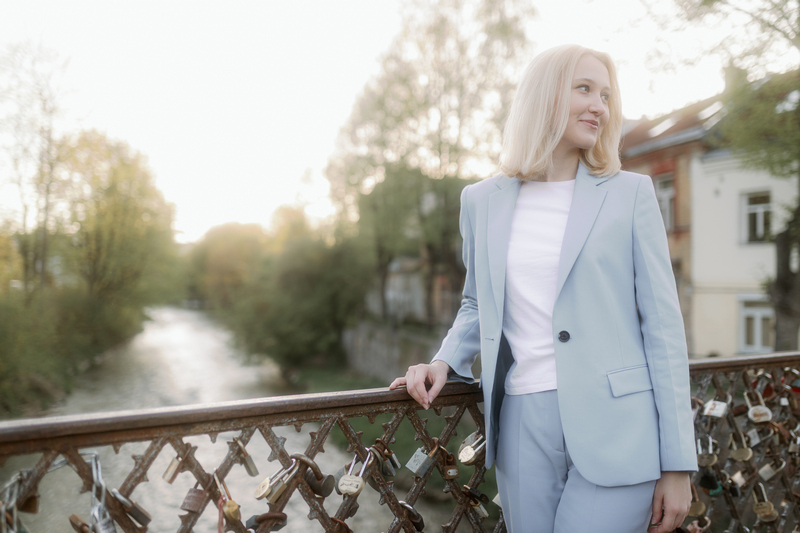
In August 2020, Belarus was swept by the largest protests in the country’s history. Millions took to the streets to voice their anger over the rigged elections and decades of authoritarian rule by Aliaksandr Lukashenka. Belarusian journalist Glafira Zhuk explains why 2020 became a turning point, how people protested, and what lies ahead for Belarus.
— Can you describe how the protest movement developed in Belarus before these events? Lukashenko’s regime has been in place for over 30 years.
— I only joined in 2020 – because of my age, I was 19 years old then. But of course, protests in Belarus existed before that. They’ve accompanied Lukashenko’s rule since 1994. There were mass demonstrations in the 1990s, especially after the 1996 referendum that consolidated power in his hands. In the 2000s, protests intensified amid the disappearances of opposition politicians and brutal crackdowns. Every presidential election – 2001, 2006, 2010, 2015 – sparked new waves of dissent. People came out not just because of election fraud, but also for social reasons – one vivid example is the 2017 mass protests against the “parasite tax,” which affected tens of thousands.
The discontent leading up to 2020 was also intensified by the COVID-19 situation. The authorities ignored the pandemic: Lukashenko publicly denied its seriousness, advised people to “treat it with a tractor,” didn’t impose lockdowns, and essentially shifted responsibility onto citizens. This caused outrage and shock – especially as society self-organized: people raised funds for doctors and coordinated hospital aid. This experience of solidarity laid the groundwork for the mass protests of summer 2020. What happened then wasn’t a sudden outburst – it was the culmination of long-standing struggle and internal readiness for change.
— Why was 2020 the breaking point? What caused such a massive eruption of anger?
— Several factors converged: decades of growing dissatisfaction with the regime, a grotesquely rigged election, unprecedented violence by the security forces, and a crisis of trust in the authorities during the pandemic. People felt they simply couldn’t endure any longer. So they came out – and they came out en masse.
— Where were you on election day, August 9–10? What did you see?
— I was downtown in Minsk. I saw everything with my own eyes – how peaceful people took to the streets and how brutally they were dispersed. Those were terrifying nights, full of violence by the security forces – and immense solidarity among Belarusians. I myself spent 30 days in Akrestina prison.
“All security forces were focused solely on repression”
— What happened after the protests were suppressed? How did the repressions unfold?
— The repressions have continued for the entire five years since. Starting around 2021, a full-blown repression machine was set in motion. A former security officer told me later that all law enforcement agencies focused exclusively on political cases. Crimes, drug trafficking, mafia – these were pushed to the background. The only priority was “political cases.”
Political prisoners began to appear, sentenced to monstrous terms. Independent media were destroyed. Around 500,000 Belarusians left the country – but I believe that number is even higher. Then came the war in Ukraine, and even in 2022, despite the danger, people still tried to protest. Some tried to stop military trains carrying Russian equipment – they received 15–20-year sentences.
As of now, there are around 1,200 political prisoners in Belarus, out of a population of 9 million. And that’s only the cases we know about. To compare, in the USSR in 1989, there were 5 political prisoners per 1 million people, in a population of over 286 million. Belarus exceeds that.
“Lukashenko releases some, but imprisons others”
— Lukashenko has started releasing political prisoners. Is this a genuine gesture?
— Not at all. Most are released under pardon from so-called “humanitarian lists” – those who are seriously ill, near the end of their sentence, or citizens of the EU or US. It’s a PR move: “Look, I’m releasing people.” But he releases 10 and arrests 15 more. The repression has not stopped, and it’s crucial to keep talking about it.
— Is it true that there are now commissions supposedly allowing emigrants to return?
— Yes, the authorities created such a commission. A person writes a letter of repentance – allegedly they can return. But there are no guarantees you won’t be arrested.
“People are jailed for likes and reposts”
— Say someone took part in the protests and wants to return. Can they be sure they’ll be safe?
— No one can know. In Belarus today, you can get a prison sentence for a like, comment, or repost of a post by an independent outlet—they’ve all been labeled extremist. At the border, they check your phone, social media, interrogate you.
— What about Belarusians abroad? Are consulates working?
— At the end of 2023, Lukashenko signed a decree banning Belarusian consulates abroad from performing their basic duties – issuing passports. You can’t renew a passport, get a certificate, power of attorney, or any official document. All of that now requires going to Belarus in person. People with expiring passports are left in limbo. Some went back to get documents – and were detained. Many are forced to live without valid papers. Some apply for travel documents – temporary ID cards valid in the EU. Others seek asylum, but that’s a long and difficult process. There was an idea to create a “New Belarus” passport – it has been created, but its recognition by other countries remains unresolved.
“I’m on an interstate wanted list”
— Often, a certificate of no criminal record is required. But most Belarusian refugees have political convictions.
— Yes, that’s a real issue. But over time, many organizations that require such certificates have started to understand our situation and no longer insist on them.
— You mentioned that you’re on an interstate wanted list?
— Yes, I am. In 2024, a criminal case was opened against me – I don’t know the charges. This year I was placed on an interstate wanted list. I can’t travel to countries that have extradition agreements with Belarus.
“Lukashenko is Putin’s vassal”
— Some opposition figures describe Belarus as occupied by Russia. What’s your view?
— Legally, Belarus isn’t under occupation – there are no internationally recognized signs of military occupation like in Crimea or Donbas. But in reality, Lukashenko’s regime increasingly depends on the Kremlin – economically, politically, in media and military terms. Since the 2020 protests and especially after the 2022 war in Ukraine, Lukashenko has become de facto Putin’s vassal. So the term “occupation” is more of a political metaphor that reflects a real sense of external control.
— Is there a risk that Belarus could be used as a staging ground to invade the Baltic states?
— In theory, yes – and many are afraid of that. But I don’t think Putin will risk it, already having an open front in Ukraine. The Baltics are right to strengthen their borders – no one expected the invasion of Ukraine in 2022 either. But personally, I find that scenario unlikely for now.
— What is Lukashenko’s level of support within Belarus?
— There are no independent polls in Belarus – it’s simply impossible to conduct them. But we know there’s an active partisan movement, independent media are still functioning, and information is passed “through fifth hands.” Everything we saw in 2020 – mass rallies, queues for alternative voting, strikes, protests even in small towns – shows that a significant part of society does not support this regime. Since 2020, Lukashenko has held power not through legitimacy, but through repression, propaganda, and Kremlin support. He has no real legitimacy.
— How is Belarusian independent journalism functioning now?
— We’re all in exile – Poland, Lithuania, other countries. Thirty-eight of our colleagues are behind bars, serving horrific sentences. Many have left the profession due to pressure and persecution. I myself spent 30 days in Okrestina prison, which is notorious for its brutal treatment of detainees, in a cell built for two, crammed with 16 women. We try to work for the internal audience. Many media projects lost up to 50% of their budgets after decisions by Donald Trump. In this context, it’s vital to preserve the independent media sector in exile – it’s an ecosystem and a lever of influence for those inside the country.
“Belarus’s future depends on the outcome of the war in Ukraine”
— How do you see Belarus’s future? Is a democratic transition possible if Lukashenko leaves?
— Today, it’s impossible to talk about Belarus’s future separate from events in Ukraine. Ukraine’s victory is a key opportunity – not only for itself, but for Belarus and the entire region. Lukashenko’s regime survives solely thanks to Kremlin support – financial, military, political. Without Putin, it wouldn’t last. So the fall of the Russian regime could trigger change in Belarus too.
International pressure must be maintained – especially through sanctions. This is one of the few peaceful tools that truly restricts the regime’s resources and increases its isolation. I understand there are differing views – some think it’s time to establish dialogue with Lukashenko to release political prisoners. But the problem is, he releases some and arrests others. The repression hasn’t stopped. What we’re fighting for is the complete cessation of repression, the release of all political prisoners, and democratic transformation.
Interview by: Mariia Kutniakova
Five years after the rigged presidential election in Belarus, which sparked nationwide protests against Alexander Lukashenka’s regime, the country’s pro-democracy movement remains alive – even if it has increasingly faded from international attention.
Austausch remains committed to the vision of a free, democratic, and European Belarus, and continues to support the Belarusian people in their struggle for human rights and democracy.
We are deeply concerned by the German government’s decision to suspend all humanitarian admission procedures as of end of July 2025 – including individual admission under Section 22(2) of the German Residence Act, which was specifically designed to provide protection for politically persecuted individuals from authoritarian regimes such as Belarus, Russia, Turkey, and from war-torn countries like Afghanistan, Syria, or Sudan.
No new programmes are currently being initiated, and visas are not being issued. Even individuals who had already received an admission commitment under Section 22 but had not yet obtained a residence permit are now left without a clear path to safety. For many, a vital legal route to protection in Germany – outside the regular asylum system – has been effectively closed.
We urge the German government to reconsider this decision. Politically persecuted pro-democracy activists urgently need safe and legal pathways. Supporting them in exile not only protects individual lives but also strengthens democratic values in Germany and across Europe.
Жыве Беларусь! (Long Live Belarus!)