
Grassroots knowledge feeds into climate risk assessments; climate policy frameworks give local action direction and legitimacy. Neither is sufficient alone for comprehensive wartime climate adaptation – and that is exactly what our panel at Café Kyiv 2026 explored.
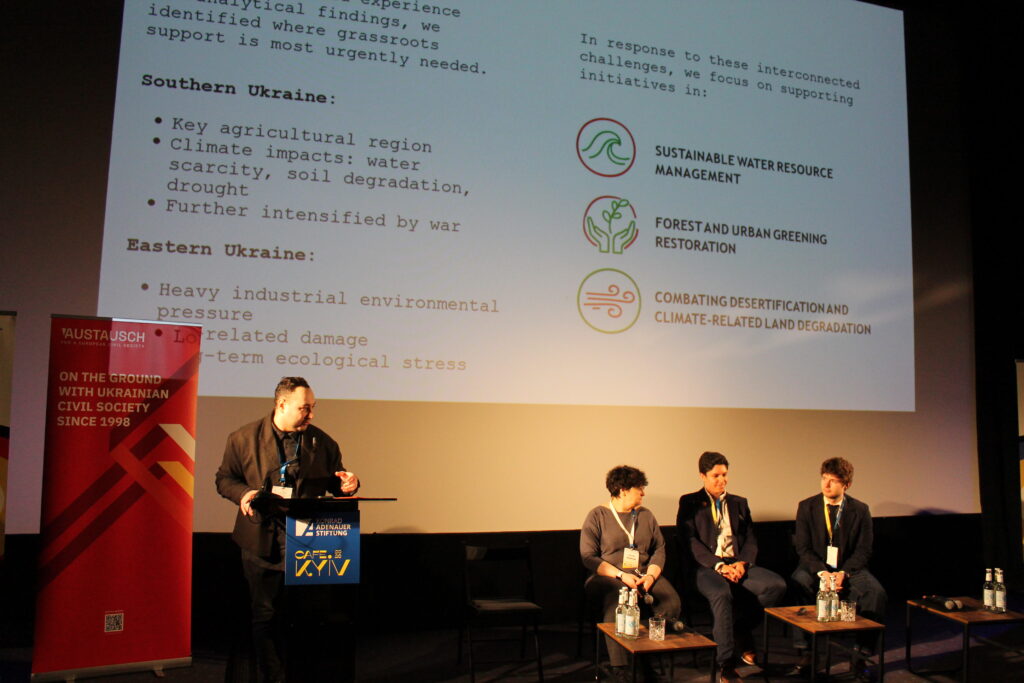
At Café Kyiv 2026, we organised a joint panel with GIZ, the Ukrainian Climate Office, the Frankfurt School of Finance and Management, and the InsuResilience Solutions Fund. Titled “Building Climate Resilience in Ukraine: Cross-Border Environmental Action and Climate Risk-Informed Adaptation,” the discussion brought together policy analysis, climate risk modelling, and practical experience from civil society environmental work. The conversation made clear that climate resilience in Ukraine cannot be put “on hold” during wartime. On the contrary, reconstruction creates a critical window of opportunity to integrate risk assessment, environmental monitoring, and community-based adaptation into long-term recovery planning.
Andres Real from the Frankfurt School of Finance and Management shared the results of a detailed flood risk study for Southern Ukraine, developed in partnership with the Ukrainian Climate Office and Lobelia Earth. The study looked at how flood risks in the Lower Dnipro Basin have changed following the destruction of the Kakhovka Dam, and how those risks are likely to evolve by 2050. It examined the potential impact on buildings, farmland, and critical infrastructure such as roads, hospitals, and utilities.
The findings are striking. By 2050, the value of assets at risk from flooding is expected to grow significantly – particularly in towns and cities. But here is the crucial insight: the main reason risk is increasing is not climate change itself, but the scale of reconstruction and development happening in flood-prone areas. In other words, if we rebuild without factoring in flood risk, we are likely locking in much greater losses for the future.
The study also found that the floods most likely to cause widespread damage are not rare, once-in-a-century events – they are moderate floods that occur every 10 to 20 years. This means adaptation measures need to be designed for realistic, recurring scenarios, not just worst-case ones.
When it comes to practical solutions, the analysis compared different flood protection options. Detention ponds – which temporarily hold excess water during heavy rainfall – and improvements to drainage systems offered the best value for money. Large-scale flood barriers or relocating communities, on the other hand, were found to be far more costly relative to their benefits. Finally, more detailed local flood mapping proved to be extremely valuable for planning, especially in areas downstream of the former dam, where water flow patterns have fundamentally changed.
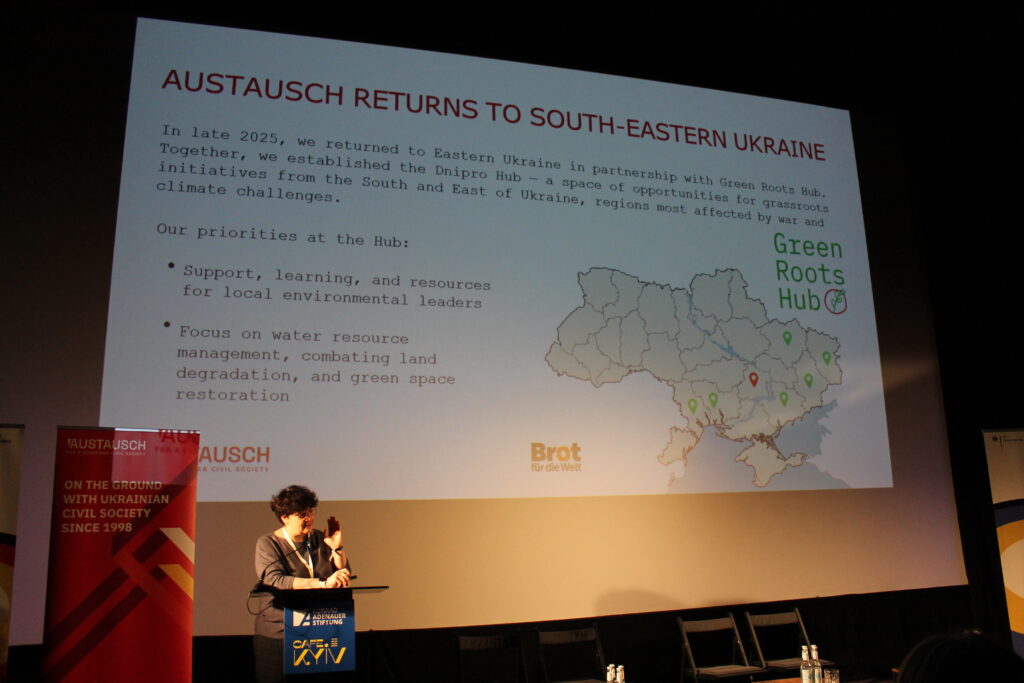
While the modelling provided a macro-level understanding of risk, Anastasiia Bondarenko, Environmental and Climate Change Project Coordinator at Austausch e.V. presented a practice-oriented perspective grounded in long-term work in Eastern and Southern Ukraine.
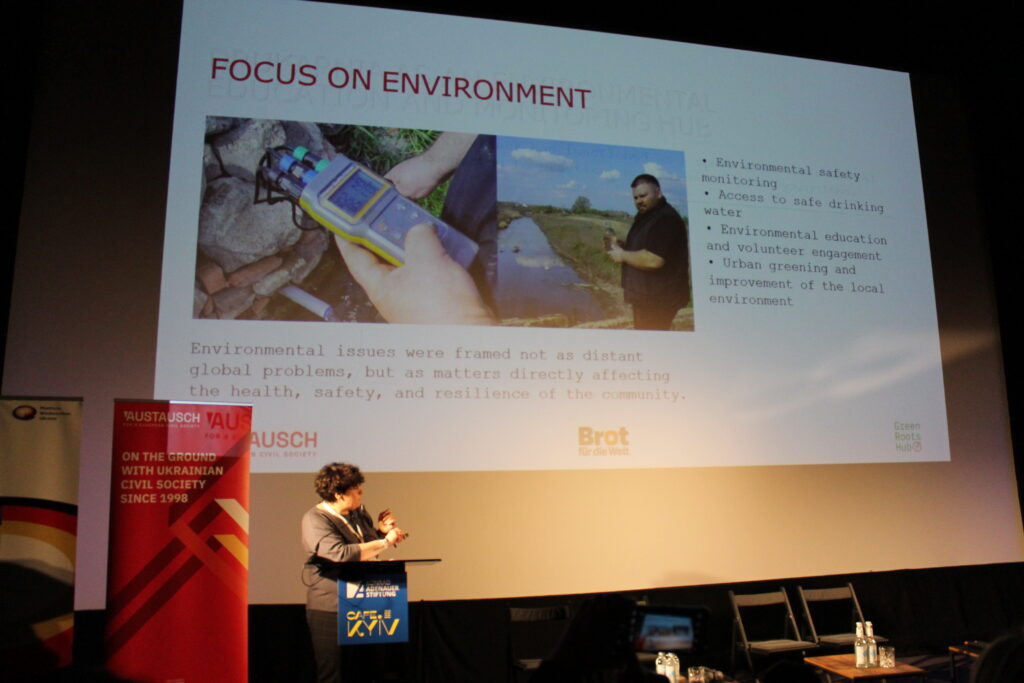
Anastasiia also shared the experience of Austausch e.V. in supporting community-based environmental initiatives and strengthening civil society at the local level. She spoke about the organisation’s long-term work aimed at developing practical environmental awareness and empowering residents and local activists to engage in environmental protection and the creation of safe and healthy living environments.
In particular, Anastasiia highlighted Austausch’s initiatives to establish educational and networking spaces that bring together activists, local organisations and community leaders. Such spaces, especially those we have developed for years in Eastern Ukraine, have played an important role in building regional networks of civic activists and increasing public awareness about environmental safety. They also introduced communities to practical tools for civic environmental monitoring, including community-based monitoring of air and water quality.
According to Anastasiia, the long-term support of such initiatives clearly shows that informed and active communities are a key foundation for building a strong and resilient state. She emphasised that supporting grassroots initiatives is essential for Ukraine’s future recovery, as local leadership and community engagement will play a crucial role in rebuilding the country.
During the panel discussion, Anastasiia also announced the creation of a new space for environmental initiatives in the city of Dnipro. The initiative is being implemented by Austausch together with its Ukrainian partner organisation GreenRoots Hub – space will serve as a platform for eco-activists and local organisations working on environmental protection, green restoration and community resilience. Following the two keynote presentations, Moritz Ridder introduced the work of the Ukrainian Climate Office – a national platform that coordinates climate adaptation efforts across Ukraine. The Office helps translate international climate commitments into practical strategies on the ground, supports data collection and risk analysis, and builds connections between government institutions, local authorities, and international partners. In the context of war and reconstruction, this coordinating role is more important than ever. Historically, Ukraine’s climate policy has focused mainly on reducing emissions; now, preparing for and adapting to climate impacts must become an equally central priority. The Ukrainian Climate Office contributes to this shift by supporting research, facilitating knowledge exchange, and helping ensure that climate risk is factored into decisions at both national and local level.
The discussion as a whole showed that building climate resilience in Ukraine requires action at multiple levels working in sync. Flood and climate risk modelling provides the hard data needed to decide where to invest and what to prioritise. Community and civil society networks ensure that those decisions reflect real local conditions and have the backing of the people they affect. National coordination bodies like the Ukrainian Climate Office connect these levels together and anchor them within broader policy. The message from the panel was clear: reconstruction that ignores climate risk will make Ukraine more vulnerable in the long run. Reconstruction that is guided by data and rooted in strong local action can do the opposite. In a time of war, climate policy is not a luxury or a distraction – it is part of securing Ukraine’s safety, stability, and its future as a European nation.