



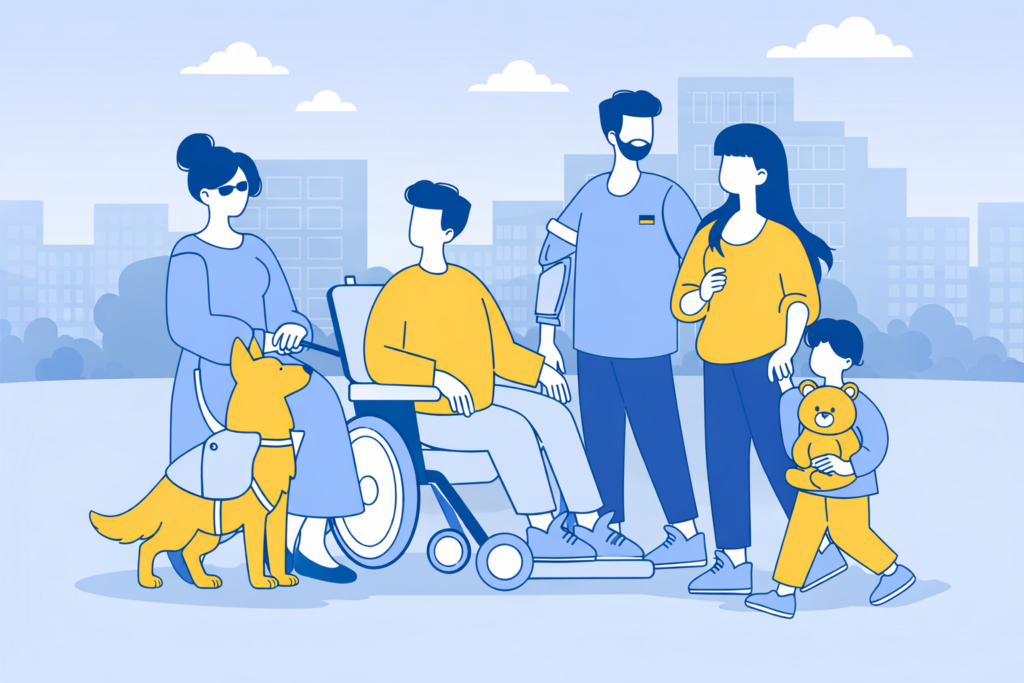

The first cross-national study of Ukrainian caregivers of persons with disabilities in the EU reveals a group caught between two systems – and falling through the cracks of both.
For the first time in Europe, a consortium of researchers from Germany, Poland, and Lithuania has systematically examined one of the most overlooked groups among the millions of Ukrainians who have fled Russia’s war: the informal caregivers of persons with disabilities. The study, titled Invisible Care, Unmet Needs, is the first of its kind to document across three EU member states and at the EU policy level – the compounded hardships facing this group, and to translate qualitative evidence into concrete policy recommendations.
Since Russia’s full-scale invasion in February 2022, more than six million Ukrainians have sought refuge across the European Union, triggering the continent’s largest displacement since the Second World War. Among them are tens of thousands of families with disabled members – and the relatives, overwhelmingly women, who care for them around the clock. These caregivers have received almost no dedicated research attention and barely register in official statistics. The new study sets out to change that.
~20% of refugee households include at least one person with a disability
80% of all long-term care in the EU is provided informally, by family members
18% employment rate among refugees from households with a disability in Germany — vs. 54% for other refugee households
A Double Burden
The research frames the situation of Ukrainian caregiver refugees as a “double burden”: they carry the hardships of displacement alongside the unrelenting demands of caring for a person with a disability. Most are women (mothers, grandmothers, aunts) who left Ukraine without their partners, often because Ukrainian men aged 18–60 were initially barred from leaving the country. Movement restrictions have since been revised, and by late 2025 adult men accounted for approximately 26% of the Ukrainian refugee population in the EU, up from earlier in the conflict. Yet the gendered caregiving structure remains largely unchanged, with women providing the vast majority of daily care.
The caregivers studied face an interlocking set of crises: inaccessible housing, administrative labyrinths, near-total exclusion from the labour market, and severe social isolation. Many cannot attend a language course, visit an employment centre, or even leave the house – because there is simply no one else to look after their disabled family member.
There is simply no time to drive to a language school and spend several hours learning the local language.
That quote, drawn from an interview with a Ukrainian caregiver in Germany, encapsulates the study’s core finding: formal entitlements exist on paper, but the lived reality for these families is one of structural exclusion.
What the Research Found
The study combined desk research, in-depth interviews with caregivers and stakeholders, focus group discussions, and analysis of national and EU-level data across Germany, Poland, and Lithuania. Because no country currently maintains a registry of informal caregiver refugees, the researchers relied on a triangulated mix of proxy indicators, administrative data, and qualitative testimony.
Invisibility in data and policy emerged as the foundational problem. Upon arrival in host countries, caregivers are registered simply as refugees. No EU country systematically collected data on disability status under the Temporary Protection Directive. This invisibility has cascading effects: without identification, there is no targeted outreach, no fast-tracked support, and no way to plan services.
Housing insecurity was cited as one of the most urgent unmet needs. Accessible housing – wheelchair-friendly, near public transport and services – is scarce and expensive. A significant proportion of families with disabled members remain in collective shelters or temporary arrangements long after arrival, long past the point when other refugees have moved into independent accommodation. In Lithuania, 45% of refugee respondents in 2023 reported experiencing discrimination when searching for housing or employment.
Labour market exclusion is near-total for caregivers of persons with high support needs. Germany’s data is particularly stark: only 18% of refugees from households including a person with a disability were employed by late 2023, compared with 54% among other refugee households. In Poland and Lithuania, NGOs report effectively zero employment among mothers of children with severe disabilities. The cause is structural: without respite care, day services, or personal assistance for the disabled family member, the caregiver cannot commit to any regular working hours.
7.7M women across the EU prevented from paid work by care responsibilities
~450k men in the same situation — a 17:1 gender gap
50% of children with disabilities in Europe cared for exclusively by parents, with no external support
Psychological strain and social isolation are pervasive. Caregivers interviewed across all three countries described being confined to the home or hospital, unable to form social connections in the host country, and managing both their own war trauma and that of the person they care for – often without any psychosocial support. The combination of displacement, caregiving intensity, and the absence of community structures constitutes what the researchers describe as a compounded vulnerability not captured by standard refugee vulnerability frameworks.
Three Countries, Three Systems
While the challenges are structurally similar, the researchers document significant variation in national responses – and in the bureaucratic experiences of caregivers depending on where they settled.
Germany
Offers the most comprehensive welfare access – Ukrainians were moved into the regular social security system from mid-2022 – but the formal procedures are highly complex. One caregiver reported waiting four months simply to obtain an appointment to submit documentation for her child’s disability assessment. During that entire period, no interim support was provided and the child received no educational or therapeutic services.
Poland
Saw a remarkable grassroots response, with civil society and volunteer networks plugging many gaps. But formal disability certification and the caregiver allowance designed to support parents who stop work to care for a disabled child – have remained largely inaccessible to refugees due to procedural backlogs and eligibility barriers. Access to support has depended heavily on proximity to an active NGO, creating deep regional unevenness.
Lithuania
Introduced an innovative “carer of a person with a disability” status, granting caregivers up to 36 months of social insurance coverage and a stipend. The measure formally recognises caregiving – something neither Germany nor Poland has done for refugees. However, it cannot be combined with employment, effectively cementing carers’ economic inactivity rather than supporting a transition to work.
The Policy-Reality Gap
A recurring theme across the study’s findings is the chasm between what EU and national policies promise and what caregivers actually experience. Ukrainian refugees under temporary protection have the right to work, access healthcare, and enrol children in school. Yet none of these rights is realised in practice for caregivers whose entire lives are organised around an unmet care need.
The researchers identify three overlapping gaps at the EU level: a policy gap, in that informal caregivers – particularly refugee caregivers — are not formally recognised in EU law; an implementation gap, in that the Temporary Protection Directive was activated without disability-sensitive guidance or monitoring mechanisms; and a coordination gap, in that refugee integration systems and disability support systems operate in separate silos, with no structured pathways between them.
The European Care Strategy (2022) and the EU’s Work-Life Balance Directive are identified as promising instruments that nonetheless fall short for this group. The Directive’s carers’ leave provision, for instance, applies only to those already in formal employment – a category that almost none of these caregivers belong to.
What the Researchers Recommend
The study addresses its recommendations to three levels: EU institutions, member states, and civil society. At the EU level, it calls for mainstreaming disability and caregiving into all migration and asylum policy, developing a common recognition of caregiver status, strengthening the enforcement of the Temporary Protection Directive with disability-sensitive indicators, and using ESF+ and AMIF funds to expand accessible housing, respite care, and psychosocial support.
For member states, the key recommendations are to prioritise refugee families with disabled members in social housing allocation, simplify access to benefits through one-stop services with interpretation support, and – critically – expand community-based disability services and respite care. The researchers emphasise that labour market inclusion measures alone cannot succeed without first reducing the care burden: without alternative care arrangements, employment policies simply shift the burden rather than lift it.
The study also calls urgently for disaggregated data collection. Without knowing how many caregiver refugees exist, where they live, and what their needs are, no effective policy response is possible. The researchers recommend that identification of disability and caregiving status become a routine part of refugee registration across all EU member states.
Rights to social protection are curtailed by practical barriers, rights to education are limited by lack of reasonable accommodations, and rights to work are nullified by inflexible labour markets and caregiving obligations.
As temporary protection for Ukrainian refugees approaches its potential expiry horizon, the study warns that current discussions about post-protection status focus primarily on employment-based residence permits – an approach that will structurally exclude full-time caregivers. Planning for this group’s long-term inclusion, the researchers argue, cannot wait.
The report represents a significant step toward making visible a population that European policy has, until now, effectively rendered invisible. Whether its recommendations translate into action will depend on whether EU institutions and member states are willing to treat caregiving not as a private family matter, but as a structural component of social protection – and a human rights issue.
This research was developed by Austausch e.V. as part of the INKuLtur programme (Berlin), in collaboration with the Lithuanian Disability Forum, the Polish Forum for People with Disabilities, and Sustento (Latvia), within the framework of the project “It’s Ability! – Fostering the Integration of Caregivers for Persons with Disabilities among Ukrainian Refugees in Germany, Poland, and Lithuania” (short title: It’s Ability!). The project is part of the Social Innovation+ Initiative funded by the European Union.
The views and opinions expressed are those of the author(s) and do not necessarily reflect those of the European Union or the European Social Fund Agency. Neither the European Union nor the Granting Authority can be held responsible for them.
#ESFplus #SocialInnovationPlus #UAprojects #EUfunds #INKuLtur #ItsAbility